Busy season does not create culture. It reveals it.
In our industry, busy season is predictable pressure. It comes every year. The deadlines are not a surprise. The volume is not a surprise. The complexity is not a surprise. Not saying we aren’t surprised it comes “so quickly” after feeling like the last busy season just ended, but as they say – the only thing certain in life is death and taxes. And we’re in the business of taxes.
What is often surprising is how teams respond.
It’s easy to slip into going through the motions as you are tired, the pressure is on, likely juggling a home life as well, and things start to slip as tensions rise. It’s not just internal pressure on the team, but juggling client requests and normal work duties as well.
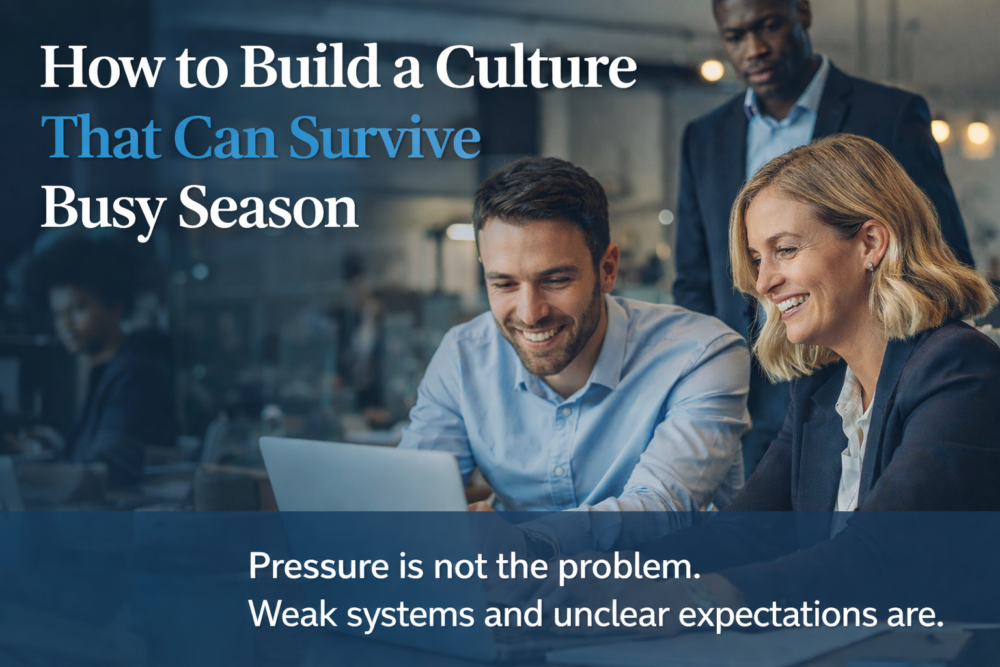
Busy season is not the problem. Weak systems and unclear expectations are. If you want a culture that survives busy season, you have to build it long before January.
We have a 50-hour tax season work week, and the key is knowing while it’s 50 hours, way less than the typical CPA average, it’s a hard 50 hours. It’s pushing your capacity to be able to get your work done, and still have a life during busy season. Not disappearing from friends/family/life for 3 months and working 70-80 hours a week.
Here is what that actually takes.
___________________________________________________________________________________________________
Clarity Before Capacity
When expectations are unclear, stress multiplies. When expectations are clear, effort feels purposeful.
Before busy season hits, we get clear on roles, accountabilities, and what “winning” looks like. This is where EOS has been critical for us. Vision without execution is chaos. Execution without vision is burnout. This isn’t saying we have 100% success rate but catching it before it takes over and redirecting to stay on track.
You cannot stack every initiative, every improvement project, and every growth goal on top of compliance deadlines and expect your team to thrive. Knowing what can be moved or put on a back burner to keep capacity and sanity is crucial.
Right people, right seats matter even more under pressure. If someone is misaligned in their role, busy season will magnify it. If they are aligned, busy season becomes a challenge, not a breaking point.
_________________________________________________________________________________________________________
Protect Energy, Not Just Output
Too many firms treat busy season like a badge of honor. Late nights. Exhaustion. Hero stories.
I am not interested in building a culture around survival stories. I’ve worked at those places before, and to be honest, part of it is playing the game to hit the hours. We want to work smarter, not punch a clock for bragging rights.
At Rohloff Associates, one of our core values is Care for People. That is not soft. It is strategic.
Caring for people does not mean lowering standards. It means designing systems where excellence does not require self-destruction. We plan for intensity. We talk openly about workload. We monitor capacity and the hours people are working to make sure they are not sacrificing themselves for a tax return.
At the end of the day, it’s taxes. Not life or death. Extensions are a tool to be used and you cannot demand high performance from depleted humans.
____________________________________________________________________________________________________
Normalize Vulnerability Under Pressure
Another core value of ours is Willing to Be Vulnerable and Trust in Evolving. These two intertwine as it is a growth stretch and change to try new things and be willing to discuss the hard things.
Busy season exposes everything. Broken processes. Unclear communication. Gaps in training. Bottlenecks in review.
The worst thing a leader can do during that time is pretend everything is fine.
If something is not working, we talk about it.
If a deadline feels unrealistic, we discuss it.
If a process is slowing us down, we fix it.
If someone is overwhelmed, we do not ignore it.
Silence during busy season is not strength. It is a bottleneck.
When leaders go first and admit what needs to improve, the team follows. That creates psychological safety. And psychological safety under pressure is a competitive advantage. It allows the team to speak up and say what isn’t working. And some of the issues we can fix, and sometimes it is acknowledging that we can’t fix it right now and need to come up with a different process. But it allows people to bring issues to the table. ____________________________________________________________________________________________________
Redefine Excellence
Our final core value is Hungry for Excellence.
But excellence is not perfection under pressure. We do not chase perfection. We chase progress with purpose. Higher performance is not about pressure. It is about curiosity, commitment, and being better tomorrow than we were today.
Too often in professional services, excellence gets confused with endurance. The person who stayed the latest. The reviewer who caught the tiniest technical issue at 11:47 pm. The team that powered through exhaustion and called it dedication. But we have found the most errors happen after working those first 60 hours. And the team takes a month to recover after the deadline.
Excellence is a senior who communicates proactively instead of going silent when they are overwhelmed.
It is a manager who flags a capacity issue early instead of absorbing it and burning out quietly.
It is a partner who adjusts a deadline expectation with a client rather than pushing the team past a healthy limit.
Excellence is not zero stress. This is a deadline-driven industry. There will be pressure. There will be long days. There will be hard weeks.
If your definition of excellence requires burnout, your culture will not survive growth. That is the kind of excellence that survives busy season.
And the kind that builds a firm that lasts.
____________________________________________________________________________________________________
Leadership Is the Difference
Busy season will always come.
The question is not whether your team can survive it. The question is whether your leadership deserves them.
Culture does not build itself under pressure. It reflects the systems, clarity, and courage you put in place before the pressure hits.
If you are leading a growing firm and want to build systems that protect both performance and people, let’s talk.